Women and Girls
Women and girls face disadvantage across many of the social and economic conditions that shape health, including income, housing, education, social connections and access to opportunity.
These inequalities are not inevitable: they are driven by structural factors, including discrimination, and they lead to shorter lives spent in worse health.
The impact is often greatest for women and girls who already face marginalisation, including women and girls from racially minoritised communities, disabled women and girls, refugees and women seeking asylum, LGBTQ+ women and girls, and women living on low incomes.
Women are more likely to be in low-paid, insecure or part-time work, to experience workplace discrimination, and to shoulder a disproportionate share of unpaid care. These pressures reduce income and security across the life course and can increase stress, limit choice and damage physical and mental health.
Recent data show a worsening picture. Across Great Britain, women’s healthy life expectancy is stagnating or falling, and the gaps between the most and least advantaged communities are widening.
Without action on the social determinants of health – including poverty, poor housing, low-paid work and discrimination – too many women and girls will continue to spend years in poor health that could be prevented.

Stating the facts
- In England, women’s healthy life expectancy at birth has fallen to 60.9 years, and the gap between the most and least deprived areas is 15.8 years.
- In Scotland, women’s healthy life expectancy has fallen to 59.4 years, with women in the most deprived areas living 10.5 fewer years in good health than those in the least deprived areas.
- In Wales, women can expect just 58.5 years of good health, and the gap between the most and least deprived areas is almost 17 years.
- Discrimination is a key driver of health inequality, shaping women’s experiences at work, in their communities and in the services they rely on.
Those that have found work sometimes have to travel miles to get to their jobs which are often low paid. During the pandemic, this has meant using public transport, even though they didn’t feel safe doing so. Being able to cycle to work has given them another option.
Leyla Laksari
Chief Executive Officer for Living Under One Sun
Our work with women and health
People’s Health Trust works with communities to tackle the root causes of health inequality. Since 2011, the Trust has partnered with more than 3,000 community organisations across Great Britain, supporting projects that help people build stronger social connections, improve confidence and skills, and grow community power.
Many of these organisations are led by women and for women, and they reach women and girls facing the sharpest inequalities in health.
This includes work through the Health Justice Fund, which supports communities affected by the building blocks of poor health such as insecure income, poor housing, limited access to advice, and discrimination. Through the Discrimination and Health programme, local people experiencing harms such as misogyny, racism, homophobia, ableism and ageism are supported to take action and secure change that benefits health. For women and girls, this matters because discrimination can shape experiences of work, safety, services, participation and belonging.
Across the Trust’s work, women and girls are improving health in ways that matter locally: creating spaces for connection, building confidence and leadership, challenging exclusion, and shaping decisions that affect their lives.
These community-led approaches show that when women and girls have power, resources and support, health can improve for individuals, families and neighbourhoods.
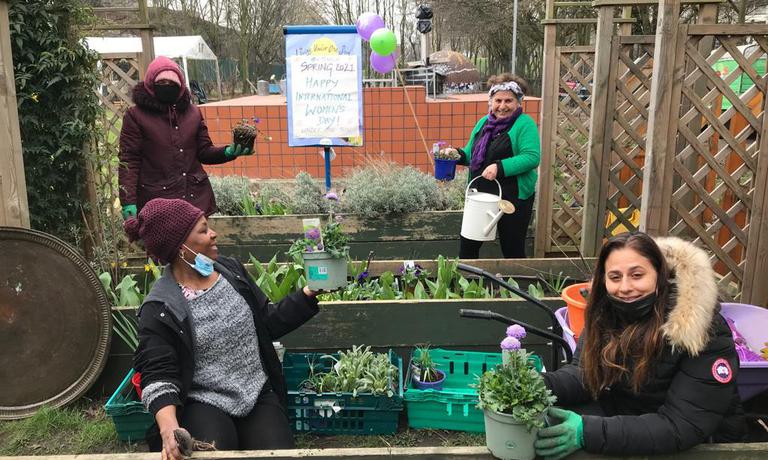

Welcome Women
Living Under One Sun was created in 2005 by a group of mothers from different cultures who wanted to feel less isolated, improve their area, and make their neighbourhood feel safer. The Welcome Women project expands on ongoing activities such as growing food.
The research on women and health
Evidence shows that women’s health is shaped by the social and economic conditions in which they live, including income, housing, work, unpaid care, access to services and discrimination.
Current data also show that women’s healthy life expectancy is stagnating or falling, with the sharpest harms experienced by women in the most disadvantaged communities. Key sources include:
- Department of Health and Social Care, Renewed Women’s Health Strategy for England (published 15 April 2026)
- People’s Health Trust, This International Women’s Day, it’s vital to confront a stark reality (06 March 2026)
- Office for National Statistics, Healthy life expectancy, UK: between 2011 to 2013 and 2022 to 2024 (released February 2026)
- Office for National Statistics, Healthy life expectancy by national area deprivation, England and Wales: between 2013 to 2015 and 2022 to 2024 (released April 2026)
- Women’s Budget Group, Health Inequalities and Gender briefing 2026 (published February 2026)